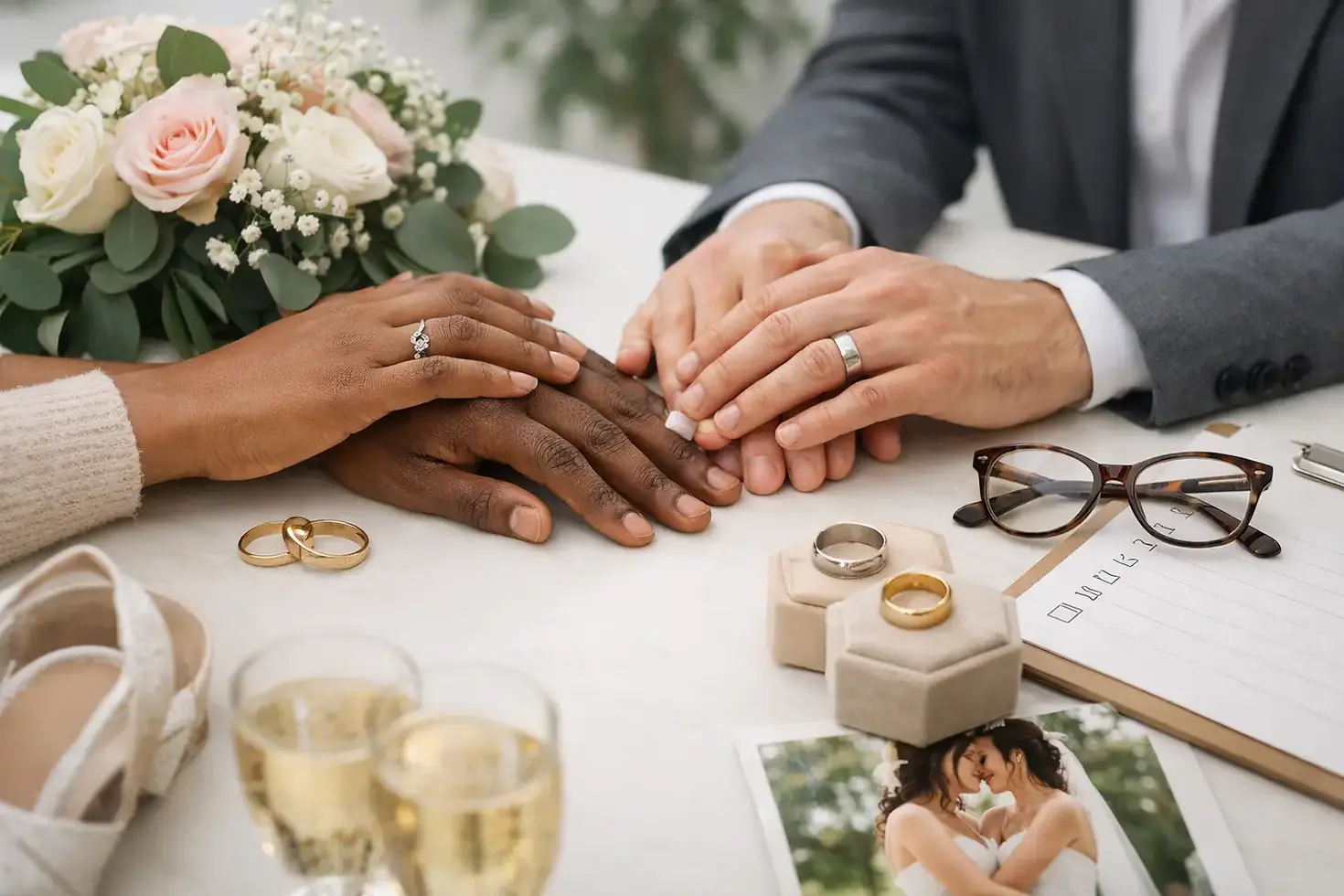
Inclusive Wedding Language Guide
The moment a ceremony begins, language starts doing quiet, powerful work. It tells your guests who belongs, what love is being honored, and whether this day reflects your real story. An inclusive wedding language guide is not about making your ceremony sound formal or cautious. It is about choosing words that feel generous, accurate, and deeply true to the people standing at the center of the moment.
For many couples, this becomes clear when they start reading sample scripts. A phrase like bride and groom may fit perfectly for some and feel wrong for others. References to being given away, to rigid gender roles, or to one narrow idea of family can create distance in a ceremony that is supposed to feel intimate. When the wording is thoughtful, everyone can settle in. The couple feels seen. The guests feel welcomed. The promises being spoken land with more meaning.
Why an inclusive wedding language guide matters
Inclusive language is not a trend layered on top of a ceremony. It is part of what makes a ceremony feel honest. Weddings gather many kinds of love, many kinds of family structures, and many different relationships to faith, culture, and tradition. The words spoken should be able to hold that complexity with care.
That does not mean every ceremony needs to sound the same. In fact, the opposite is true. Some couples want language that is explicitly spiritual. Some want something secular and simple. Some want to honor cultural rituals while adjusting outdated wording. Some are planning a second marriage and want language that reflects wisdom, blended families, or a love that arrived later in life. Inclusivity is not one script. It is the practice of paying attention.
A well-shaped ceremony also avoids making guests do emotional translation. If your best friends, siblings, children, parents, or chosen family are present, the language should not quietly place some of them outside the circle. Small shifts can make a profound difference.
The heart of inclusive wedding language
At its core, inclusive wording is language that names people as they are rather than forcing them into a template. That may sound simple, but it touches almost every part of a ceremony.
It begins with how the couple is addressed. Some people love bride and groom. Others prefer partners, spouses-to-be, nearlyweds, or simply their names. The right choice depends on identity, style, and tone. There is no virtue in sounding neutral if the couple wants joyful, traditional language. There is also no reason to use traditional labels when they do not fit. The best wording is the wording that feels like home.
Family language matters too. Not every parent is a mother or father. Not every meaningful relative is related by blood. Not every person who raised you fits a conventional title. Saying parents, family, loved ones, or those who have guided and supported them can open space where more specific terms may feel too narrow.
Even familiar ritual language deserves a second look. Ask who is being centered by a phrase and who may be left out. Ask whether a line reflects the values of the couple or simply habit.
Inclusive wedding language guide for common ceremony moments
The processional often carries old assumptions. “Who gives this woman to be married” is still common, but many couples find that it suggests transfer, ownership, or dependence. If you want to honor the significance of being accompanied down the aisle, there are warmer alternatives. You might acknowledge support instead of permission, or simply allow the walk itself to speak without commentary.
Introductions deserve equal care. “Dearly beloved” still works beautifully for many ceremonies, but the rest of the welcome can widen the circle. Naming guests as family, friends, and cherished community members creates an immediate sense of belonging. If children, stepchildren, godparents, grandparents, or chosen family are central to the day, the opening can gently reflect that.
Readings and reflections are another place where inclusion matters. Many well-known wedding readings are lovely, but some lean heavily on dated ideas about duty, hierarchy, or gendered roles. That does not make them unusable. It simply means they should be chosen with intention. A reading should sound like it recognizes the relationship you actually have, not one you are expected to imitate.
Vows often reveal the strongest contrast between generic and personal language. Traditional vows can be deeply moving, especially when a couple feels connected to their history and rhythm. Personalized vows can be just as sacred, especially when they name the real promises this particular relationship is built on. Inclusive vows are not necessarily less traditional or more modern. They are simply more precise about who is making the promise and what they are promising.
Pronouns also matter, and not only for the couple. Wedding parties, family members, and anyone being acknowledged during the ceremony deserve to be referred to correctly. This is one of the clearest ways respect becomes visible in a room.
Inclusion does not mean losing beauty or tradition
Some couples worry that once they start adjusting language, the ceremony will lose its poetry or sense of reverence. In practice, the opposite is often true. When words feel more accurate, they tend to feel more moving too.
A traditional ceremony can still be inclusive. A Christian ceremony can still be inclusive. A ceremony with cultural customs can still be inclusive. The question is not whether you must abandon heritage. The question is how to carry it forward faithfully, without repeating language that no longer reflects your values.
Sometimes that means making only a few gentle edits. Other times it means rewriting entire sections so the ceremony fits a blended family, a queer couple, an interfaith partnership, or a pair of people who do not relate to marriage as ownership, obedience, or fixed roles. There is no single right degree of change. It depends on what you want the room to feel.
How to choose words that feel personal and welcoming
Start with honesty, not etiquette. Ask yourselves which words you naturally use when you talk about each other. Do you say husband and wife, wives, husbands, spouses, partners, beloveds, or something else entirely? The language that appears in your ceremony should not feel borrowed from strangers.
Then consider your guests. Not because the ceremony needs to please everyone, but because a wedding is communal by nature. If the day includes multiple generations, different faith backgrounds, divorced parents, stepparents, children, or chosen family, your wording can hold that complexity with grace. Inclusive language is often less about avoiding offense and more about offering recognition.
It also helps to identify the phrases that make you pause. If a line sounds lovely but does not quite sit right, trust that feeling. Usually there is a reason. Maybe it assumes one partner is leading and the other following. Maybe it treats marriage as completion instead of companionship. Maybe it speaks about family in a way that excludes people you love most. Those moments are worth revising.
This is where a skilled officiant can make an enormous difference. Ceremony writing is not just arranging attractive words. It is listening for the emotional truth underneath them. At Ceremonies By Hans, that often means shaping language that honors tradition where it matters and softens or replaces it where it does not.
What inclusive wording can sound like
Inclusive language does not need to announce itself. Often it is simple, clear, and almost invisible in the best way.
Instead of speaking about two halves becoming one, you might speak about two whole people choosing one another with openness and devotion. Instead of referring only to the families they come from, you might honor all those who have loved, raised, encouraged, and shaped them. Instead of describing marriage through duty alone, you might name friendship, tenderness, resilience, delight, and shared responsibility.
That shift matters because language creates emotional architecture. It tells the couple what kind of marriage is being blessed and what kind of love is being witnessed. If the wording is expansive, grounded, and true, the ceremony can feel both more sacred and more human.
A ceremony should sound like your values
The right words do more than avoid exclusion. They create belonging. They let your ceremony reflect the way you actually love, the people who actually hold your lives together, and the future you are intentionally stepping into.
If you are building your ceremony now, give yourselves permission to question familiar phrases and keep only what feels meaningful. The most memorable ceremonies are rarely the ones that sound the most standard. They are the ones where every word feels lived in, chosen with care, and spoken as if it could only belong to these two people, on this day, before this community.
That is the quiet gift of thoughtful language. It makes room for everyone, and it lets your promises sound like your own.


Comments