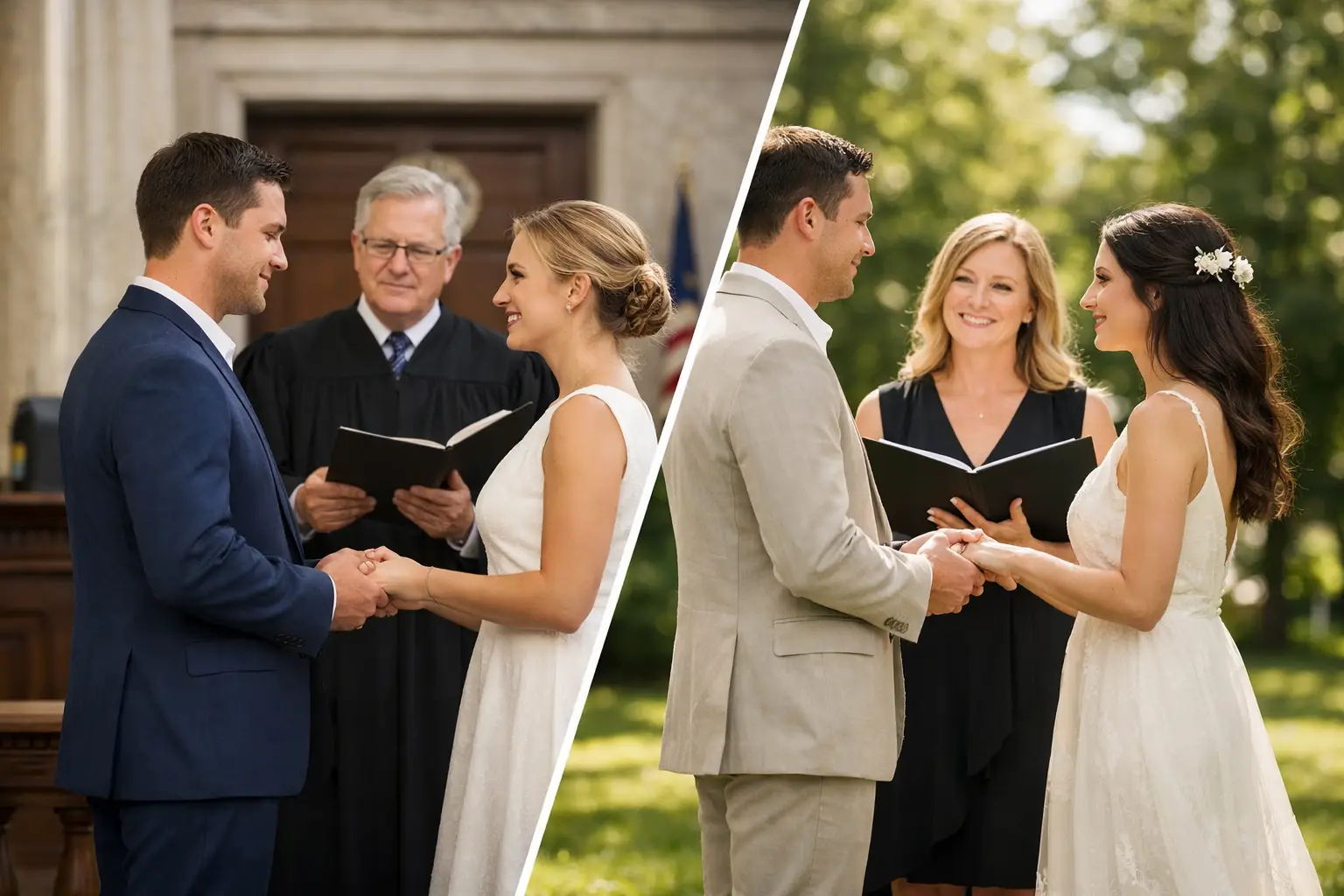
Courthouse Wedding vs Officiant: Which Fits?
Some couples know exactly what they want the moment they get engaged. Others pause at one very practical, very emotional question: courthouse wedding vs officiant - which one actually feels right for us?
It is a fair question, because this choice is not only about paperwork. It is about tone, memory, and the kind of moment you want to step into when you say yes to each other. For some couples, simple and efficient is the dream. For others, a legal ceremony alone feels too thin for a promise that carries so much heart.
Courthouse wedding vs officiant: what is the actual difference?
At the most basic level, both options can make your marriage legal. The difference is usually in the experience.
A courthouse wedding is typically civil, brief, and structured around administrative efficiency. You arrive at a government location, follow the required process, and complete the legal act of marriage. For many couples, that simplicity is the appeal. There is less planning, less pressure, and often a more streamlined path.
An officiant-led wedding can also be legally binding, but it allows far more room for intention and personality. The officiant is not just there to witness signatures. In the best version of this experience, they guide the emotional center of the ceremony, shape the language, and create a moment that sounds and feels like the two people standing in it.
That means the real comparison is not only courthouse versus private ceremony. It is efficiency versus personalization, structure versus flexibility, legal function versus legal function plus meaning.
When a courthouse wedding makes the most sense
There is nothing lesser about wanting a courthouse wedding. In fact, for the right couple, it can be deeply honest.
Some couples are private and do not want a public expression of their vows. Some are navigating family tension, budget limitations, travel logistics, immigration timing, military timelines, or a season of life where keeping things simple feels wise. Others genuinely love the understated beauty of a quiet legal appointment followed by dinner with the people they love most.
A courthouse wedding often works best when your top priorities are speed, clarity, and minimal planning. If the legal marriage itself is the main goal, and the ceremonial atmosphere matters less, this route can feel like relief.
There is also a particular tenderness in choosing simplicity on purpose. A short civil ceremony can still be emotional. It can still carry weight. It can still mark the start of a beautiful marriage. Not every love story needs a long aisle or a handcrafted script to be real.
When choosing an officiant changes everything
The reason many couples choose an officiant is simple: they want the ceremony to feel like more than a formality.
A personalized officiant-led ceremony makes room for your story. It lets you choose the setting, the pacing, the tone, and the words that will frame one of the most meaningful promises of your life. Instead of fitting yourselves into a standard script, the ceremony is shaped around who you are.
That might mean including your children. It might mean honoring a parent who has passed. It might mean speaking in spiritual language, secular language, or something in between. It might mean writing vows that are poetic, plainspoken, funny, or deeply intimate. Those choices matter because they create recognition. You hear your relationship reflected back to you.
For couples who value authenticity, that can be transformative. The ceremony becomes more than a legal checkpoint. It becomes a sacred pause where your commitment is named with care.
This is where an experienced officiant brings something a courthouse usually cannot. They hold both the legal responsibility and the emotional atmosphere. They know how to calm nerves, guide the room, keep the moment grounded, and speak words that land with sincerity instead of sounding generic.
Cost matters, but value matters too
Cost is often part of the courthouse wedding vs officiant decision, and understandably so.
A courthouse wedding is often the less expensive option upfront. If you are looking at the most economical path to legal marriage, it may be the obvious choice. You are usually paying for the civil process, not for a customized ceremony experience.
Hiring an officiant typically costs more because it includes more. Depending on the service, that may involve consultations, ceremony design, custom writing, rehearsal support, travel, and the professional delivery of the ceremony itself. You are not only paying for someone to show up and sign documents. You are investing in how the moment feels and how it will be remembered.
That does not mean one is inherently better. It means they offer different kinds of value.
If your budget is tight but meaning is important to you, there is also a middle path. Some couples complete the legal marriage at the courthouse and then hold a separate ceremony with an officiant later. Others choose a simple officiant-led elopement that is intimate but still deeply personal. You do not have to choose between practical and heartfelt if your circumstances call for both.
Flexibility is where officiants usually stand apart
One of the biggest differences between a courthouse and an officiant is flexibility.
With a courthouse wedding, you are usually working within the institution's schedule, space, and process. That can be perfectly fine if your needs are straightforward. But it may feel limiting if you want to choose your own location, include personal readings, invite a specific number of guests, or create a particular atmosphere.
With an officiant, there is usually much more room to shape the ceremony around your values and your day. You can marry in a backyard, on a beach, in a family home, at a restaurant, in a forest clearing, or in a small event space filled with candlelight and your favorite people. The setting itself becomes part of the story.
Flexibility also matters emotionally. Some couples want laughter woven into the ceremony. Others want reverence. Others want something inclusive and nontraditional that does not borrow language that feels disconnected from their beliefs. A skilled officiant can hold that nuance.
The emotional question most couples are really asking
Underneath courthouse wedding vs officiant, the deeper question is often this: what do we want to remember?
Years from now, many couples will not remember the exact filing process or the administrative steps. They will remember the room. The voice. The look they gave each other. The feeling in their chest when the words finally matched the meaning of the day.
If you want a quiet legal milestone with little fuss, a courthouse may be exactly right. If you want your ceremony to feel intimate, expressive, and unmistakably yours, an officiant is often the better fit.
Neither answer is wrong. The wrong choice is the one that leaves you feeling disconnected from your own wedding day.
How to decide without second-guessing yourself
Start with honesty, not expectation. Ask yourselves what matters most when you picture the day.
Do you want this moment to be private and efficient, or do you want it to feel curated and personal? Are you looking for the simplest legal path, or do you want someone to help transform the ceremony into a meaningful experience? Are you trying to reduce stress, or would personal guidance actually make you feel more at ease?
It also helps to think beyond aesthetics. Some couples imagine they need a courthouse because they do not want anything elaborate, when what they really want is intimacy. Those are not the same thing. An officiant-led ceremony can be simple without being impersonal. It can be elegant without being performative.
Likewise, some couples assume a courthouse will feel cold, only to find that the simplicity suits them beautifully. What matters is whether the format reflects your actual values, not someone else's idea of what a wedding should look like.
For couples who want legal clarity and emotional depth, working with a thoughtful officiant can offer both. That is especially true when the ceremony is written with care and shaped around your story rather than pulled from a template. Ceremonies By Hans is built around that kind of experience - one where the legal act is honored, but the heart of the moment is never treated as an afterthought.
A wedding ceremony does not need to be extravagant to be unforgettable. It only needs to feel true. If the courthouse gives you that truth, trust it. If a personalized officiant-led ceremony gives you language for a love that deserves to be spoken with care, trust that too.
The best choice is the one that lets you stand in the moment and feel, without hesitation, that this is the right beginning for your marriage.


Comments