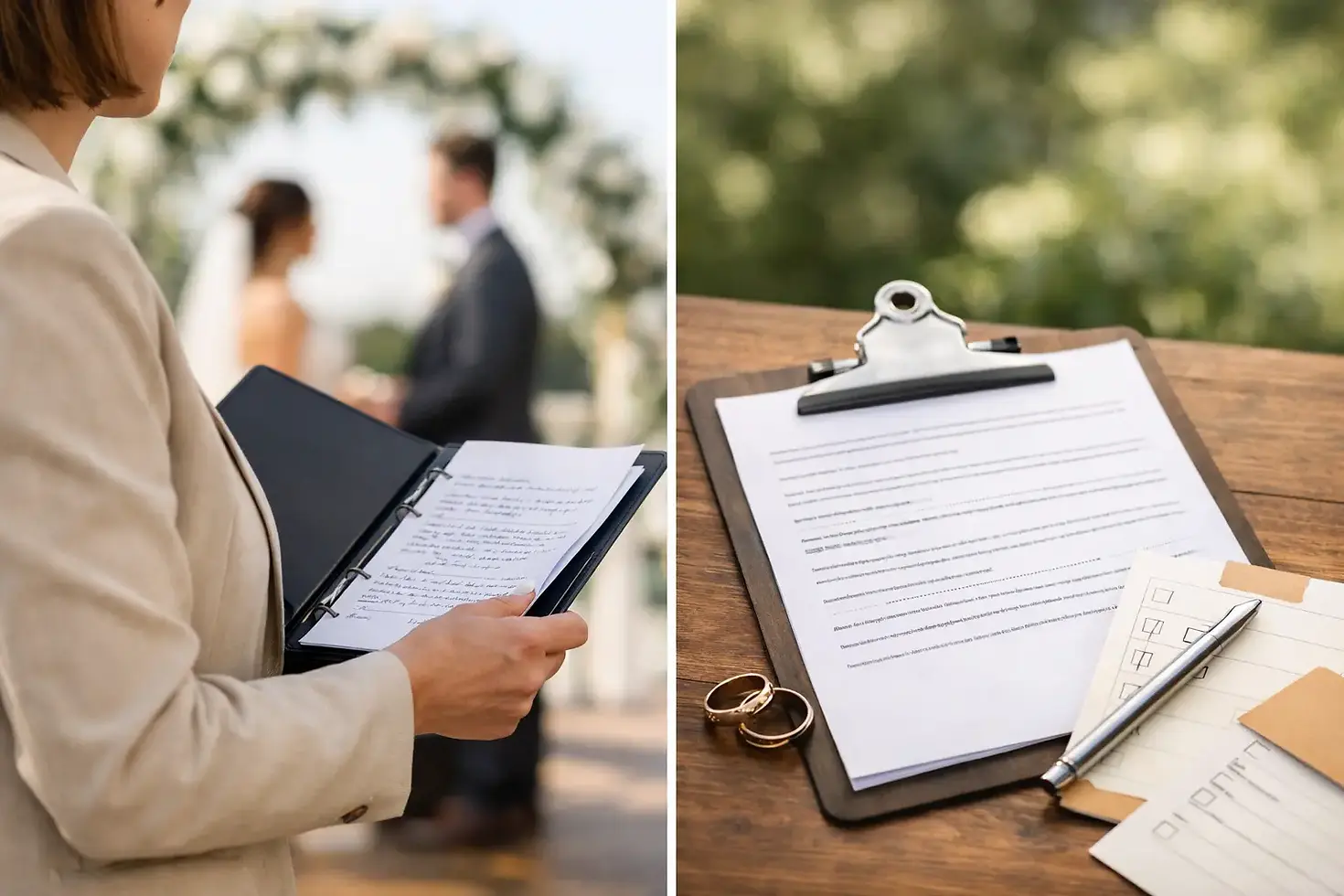
Custom Ceremony or Template Script?
A couple can spend months choosing the right setting, the right music, the right clothes, and the right people to stand beside them - then hand the most meaningful moment of the day to words that could belong to anyone. That is usually the real question behind custom ceremony or template script. It is not simply about format. It is about whether the ceremony sounds like your life, your love, and your promises, or whether it sounds borrowed.
For some couples and families, a template offers comfort. It gives structure, familiar rhythms, and a clear sense of what comes next. There is nothing wrong with that. Familiar language can feel steadying, especially when emotions are high and the day moves quickly.
But a ceremony is not only there to keep the event moving. It sets the emotional tone for the entire gathering. It tells your guests what this moment means. It creates the bridge between paperwork and memory, between an event on the calendar and a sacred turning point in your life.
Custom ceremony or template script: what is the real difference?
A template script is usually built from standard phrasing. It may include a welcome, a reading, a statement about marriage or family, vows, a ring exchange, and a pronouncement. The order works. The language is often polished. It can be efficient and perfectly acceptable for people who want something brief and traditional.
A custom ceremony begins in a different place. It starts with listening. Instead of fitting your story into predetermined wording, the script is shaped around who you are. Your ceremony may still include familiar elements, but the language is written to reflect your relationship, your values, your spiritual comfort level, your family dynamics, and the atmosphere you want to create.
That distinction matters more than many people realize. Guests may not know whether a script was written from scratch, but they can feel the difference. When the words are personal, people lean in. They laugh at the right moments. They tear up without forcing it. They recognize the couple or family standing in front of them.
When the words are generic, the ceremony can still be nice. It can still be smooth. But it often passes by without leaving much behind.
When a template script makes sense
There are times when a template is the right choice. If you want a very short legal ceremony with minimal personalization, a template can keep things simple. If you are planning quickly, prefer traditional wording, or feel uneasy about being the center of attention, a familiar script may feel grounding.
Some couples also assume they do not have much of a story to tell. They say things like, "We are pretty low-key," or, "Nothing dramatic happened, we just love each other." That kind of love story is still a story. Quiet devotion, long friendship, second-chance love, blended family life, private commitment after hardship - these are not empty spaces. They are often the most moving material a ceremony can hold.
Still, if your priority is brevity over emotional texture, a template may serve you well. The key is choosing it intentionally, not by default.
Why a custom ceremony changes the experience
A custom script does more than add personal details. It changes the emotional architecture of the ceremony.
When your officiant understands how you met, what you have weathered, what you value, and how you want people to feel in the room, the ceremony can be written with care instead of assumption. That means the tone can be romantic without becoming theatrical, spiritual without feeling exclusive, and heartfelt without sliding into clichés.
This is especially important for couples and families who do not see themselves reflected in standard ceremony language. Maybe you want something inclusive and modern. Maybe you are blending religious and secular elements. Maybe this is a vow renewal after years of shared life, not the beginning of the story but a deeper chapter in it. Maybe your family dedication ceremony needs to honor chosen family, grandparents, siblings, or a path that has not looked traditional.
Template scripts often struggle with nuance. They are designed to cover many situations reasonably well. A custom ceremony is designed to honor your specific one beautifully.
The emotional risk of generic words
Most people do not regret having too much meaning in their ceremony. They regret holding back from it.
This often happens because they are trying to avoid something awkward or overly sentimental. That instinct is understandable. No one wants a ceremony that feels stiff, performative, or emotionally inflated. But there is a difference between tasteful restraint and emotional distance.
Generic wording can create that distance without anyone intending it. You hear broad statements about love, commitment, and partnership, but nothing roots those ideas in the reality of the people standing there. The ceremony sounds correct, yet not quite alive.
On the other hand, personalization does not require a dramatic production. Sometimes one carefully written paragraph about how two people built trust, or how a family came together, says more than a dozen standard lines ever could. The point is not to impress guests. The point is to speak truthfully enough that everyone present can witness something real.
What a custom ceremony script can include
A custom ceremony does not have to mean completely rewriting every tradition. It can be as layered or as simple as you want.
For some people, customization means weaving in the story of how they met, the values that guide their partnership, and a tone that feels more like them. For others, it means creating a ceremony structure from the ground up, including nonreligious blessings, family acknowledgments, rituals, shared vows, or language that reflects a multicultural or blended identity.
The most meaningful ceremonies usually balance the familiar with the personal. Guests appreciate a flow they can follow, but they remember the details that belong only to you. That could be a line about resilience, a nod to your children, a blessing over your next chapter, or a simple phrase that captures the spirit of your relationship better than any stock wording could.
This is where thoughtful ceremony writing becomes an art. Not every personal detail belongs in the script. Discernment matters. A well-crafted custom ceremony selects the right details, shapes them with intention, and gives them enough room to breathe.
How to decide between custom ceremony or template script
If you are unsure which path fits you, ask a different set of questions. Not "What do most people do?" but "What do we want this moment to feel like when we hear it out loud?" Do you want efficient and familiar, or intimate and unmistakably your own? Do you want words that complete the legal and social function of the day, or words that help define it?
It also helps to think beyond the ceremony itself. Years from now, what do you want to remember? The logistics will blur. The details of timing, seating, and weather often fade. What stays is how the moment felt in your body and in your heart. Whether you felt seen. Whether the words sounded true.
For many couples and families, the right answer is not an all-or-nothing choice. A strong officiant can take the clarity of a proven structure and pair it with language that feels handcrafted. That middle ground often gives people the reassurance of flow with the emotional richness of personalization.
At Ceremonies By Hans, that is often where the most soulful work lives - not in abandoning structure for the sake of novelty, but in shaping each ceremony so it feels honest, intimate, and fully aligned with the people at its center.
The best script is the one that sounds like you
A ceremony should never feel like a performance of someone else’s idea of love, marriage, renewal, or family. It should sound like your voice, even when spoken by an officiant. It should carry your values with grace. It should hold the weight of the moment without becoming heavy.
Whether you choose a template, a custom script, or something in between, the most meaningful choice is the one made with intention. If familiar words bring you peace, honor that. If your heart wants language that reflects your real story, honor that too.
The ceremony is where your promises first take shape in public. Give those words the same care you have given the life they are meant to bless.


Comments