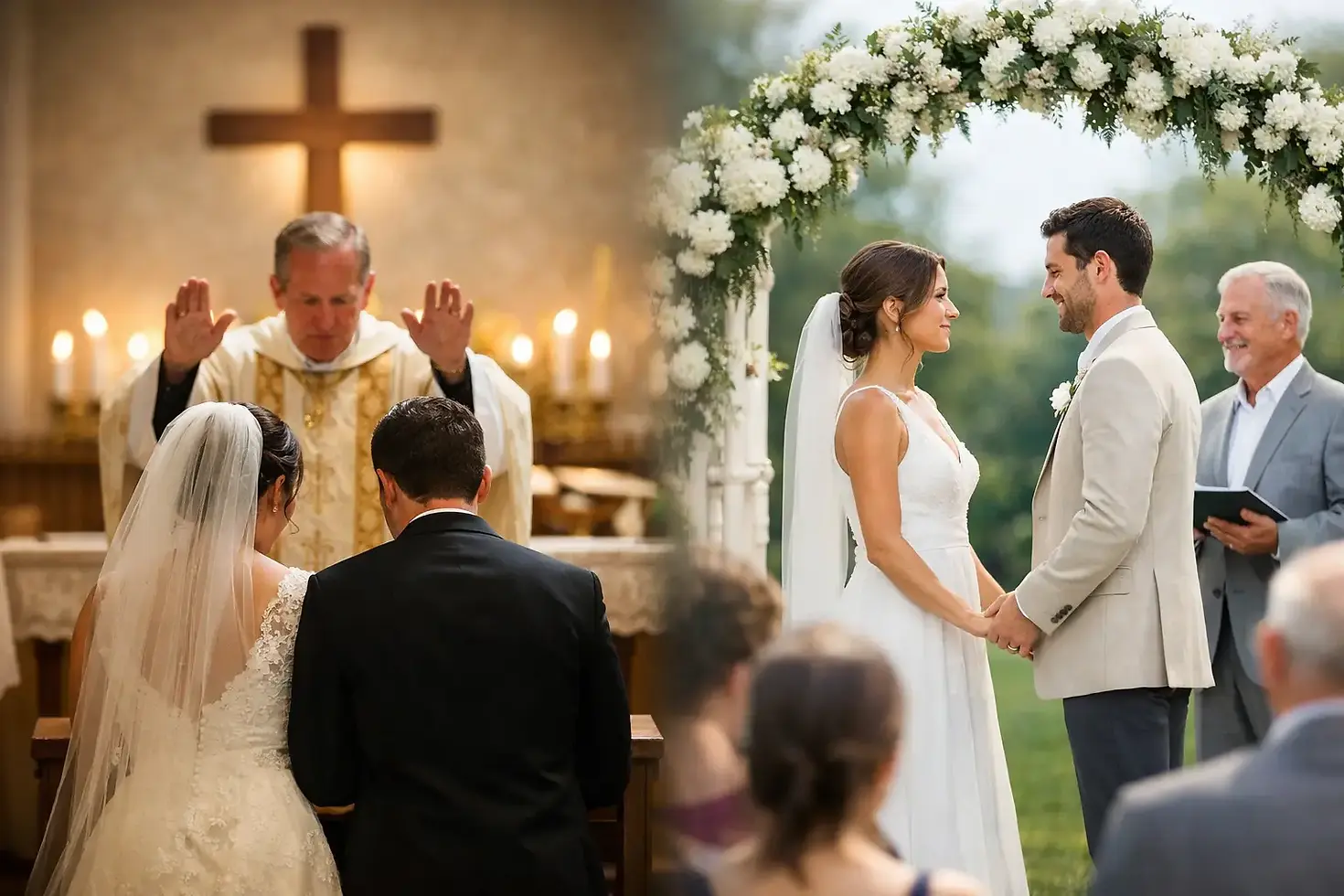
Religious vs Secular Wedding Ceremony
The moment many couples get stuck is not the venue, the flowers, or even the guest list. It is the ceremony. When you start weighing a religious vs secular wedding ceremony, you are really asking a more intimate question: What do we want this moment to mean, and how do we want it spoken aloud?
That decision can feel tender, especially when family history, personal belief, and shared values do not line up neatly. Some couples know right away that they want a faith-based service rooted in tradition. Others want a fully nonreligious ceremony that reflects their relationship without formal doctrine. Many fall somewhere in between, wanting something reverent and heartfelt without feeling confined by language that does not quite fit.
Religious vs secular wedding ceremony: what is the real difference?
At the simplest level, a religious wedding ceremony is shaped by a specific faith tradition. Its wording, structure, rituals, and meaning are usually connected to shared beliefs about marriage, covenant, God, and community. It may take place in a house of worship, be led by clergy, and include sacred readings, prayers, blessings, or rituals required by that tradition.
A secular wedding ceremony is not rooted in a particular religion. It can still be deeply meaningful, solemn, and even spiritual in feeling, but it does not rely on faith-specific doctrine or language. Instead, it often centers on the couple's story, their promises, their values, and the life they are building together.
That said, this is not always a clean line. Some secular ceremonies include moments of reflection that feel sacred without being religious. Some religious ceremonies are gently adapted to feel more personal and intimate. And many couples choose a middle path, with language that honors family background while remaining inclusive to everyone present.
What a religious ceremony can offer
For many couples, a religious ceremony brings a sense of continuity. The words have been spoken before. The rituals carry inherited meaning. There is comfort in stepping into something larger than yourselves, especially if faith has shaped your family life, your values, or your understanding of marriage.
A religious ceremony can also create a powerful sense of belonging. Parents and grandparents may recognize the structure, the prayers, or the blessings. Guests who share your tradition often feel immediately grounded in the moment. There is a communal quality to it, as if your marriage is being witnessed not only by loved ones, but by a faith community and a sacred history.
But that same strength can also be a limitation, depending on your situation. Some traditions have strict requirements around wording, setting, premarital preparation, or who may officiate. If one partner is not religious, or if you come from different faith backgrounds, parts of the ceremony may feel uneven or emotionally complicated. Even for couples with some spiritual connection, traditional language can sometimes feel more inherited than personal.
None of that makes a religious ceremony less meaningful. It simply means the fit matters. The most moving ceremonies are not chosen out of obligation. They are chosen because the words feel true.
What a secular ceremony can offer
A secular ceremony gives you room to create from the inside out. Instead of beginning with a prescribed format, you begin with your relationship. How did you meet? What have you weathered together? What promises matter most to you? What tone feels right - joyful, quiet, playful, poetic, grounded?
For couples who are not religious, this freedom can feel like relief. There is no need to borrow language that feels distant. You can speak plainly, warmly, and honestly. You can make space for emotion without performing tradition for tradition's sake.
A secular ceremony is also often more inclusive for mixed-belief families and guest lists. If your loved ones include people of different faiths, no faith, or complex experiences with religion, a nonreligious ceremony can feel welcoming without becoming flat or generic. The key is intention. Secular does not have to mean stripped down. It can still feel sacred because of the care given to every word.
The trade-off is that freedom can be overwhelming. Without a clear structure, some couples worry the ceremony will feel less significant or too casual. Others struggle to find language that is elevated enough for the moment without sounding stiff. This is often where thoughtful ceremony design matters most. A secular ceremony needs shape, rhythm, and emotional depth. Otherwise, it can drift into something that feels more like a script than a rite of passage.
How to choose between a religious vs secular wedding ceremony
The best choice usually comes from honest conversation, not quick preference. Start with what marriage means to each of you. Not the reception, not the aesthetics, but the actual act of standing up and making vows.
If faith is central to one or both of you, ask how that should be expressed. Does it need to be explicit and traditional? Would a blessing or reading be enough? Are there rituals you genuinely want, or are there elements you feel expected to include for someone else's comfort?
If you are leaning secular, ask what kind of feeling you still want the ceremony to carry. Quiet reverence? Warmth? Family connection? A sense of the sacred without religion? Those answers help shape a ceremony that feels substantial rather than simply nontraditional.
It also helps to talk about your guests, but not in a way that gives them full veto power. Family expectations are real. A parent may feel grief if a long-held tradition is not included. Another family member may feel uneasy with overtly religious language. These feelings matter, but they should not drown out your own. The ceremony is one of the few parts of the wedding that truly belongs to the couple at the center of it.
You do not always have to choose one or the other
Some of the most beautiful ceremonies live in the space between categories. A couple may choose a secular structure with a short prayer from a grandparent. Another may include a reading from scripture alongside personal vows and contemporary reflections. Some want spiritual language like grace, blessing, or sacred promise, but do not want the ceremony tied to one religion.
This kind of blending works best when it is done with clarity. If you include a religious element, let it be meaningful rather than decorative. If you choose inclusive language, let it still carry weight. The goal is not to satisfy every possible perspective. It is to create a ceremony that feels coherent, intentional, and honest.
That is often where custom writing becomes so valuable. When a ceremony is written around your real story, the words can hold complexity without sounding confused. They can honor family roots, personal belief, and shared values in a way that feels natural rather than pieced together.
Questions worth asking before you decide
Before settling on a direction, sit with a few gentle but revealing questions. When you imagine the ceremony, do you picture tradition, stillness, and sacred ritual? Or do you picture language that sounds unmistakably like the two of you? Do you want your officiant to guide you within an established faith framework, or to help shape something more personalized and open?
It is also worth asking what would make you feel most present on the day itself. For some couples, familiar prayers create calm. For others, unfamiliar religious wording creates distance. The right ceremony is often the one that lets you stay emotionally inside the moment instead of managing discomfort through it.
If you are planning in Ontario and want something personal, collaborative, and deeply reflective of who you are, working with an officiant like Ceremonies By Hans can make the decision feel less like choosing a category and more like crafting an experience that fits.
What matters most
A wedding ceremony does not become meaningful because it is religious. It does not become meaningful because it is secular. It becomes meaningful when the words, structure, and atmosphere tell the truth about the life you are entering together.
Some couples find that truth in ancient rituals. Some find it in original vows spoken under open sky. Some find it in a ceremony that borrows gently from faith while making room for a wider, more personal understanding of love and commitment.
You do not owe anyone a performance of belief. You do not need to reject tradition just to feel modern, and you do not need to choose a secular path just because it seems easier to customize. The most memorable ceremony is usually the one that sounds like your values, honors your story, and leaves you both feeling deeply recognized in the moment you say yes.


Comments