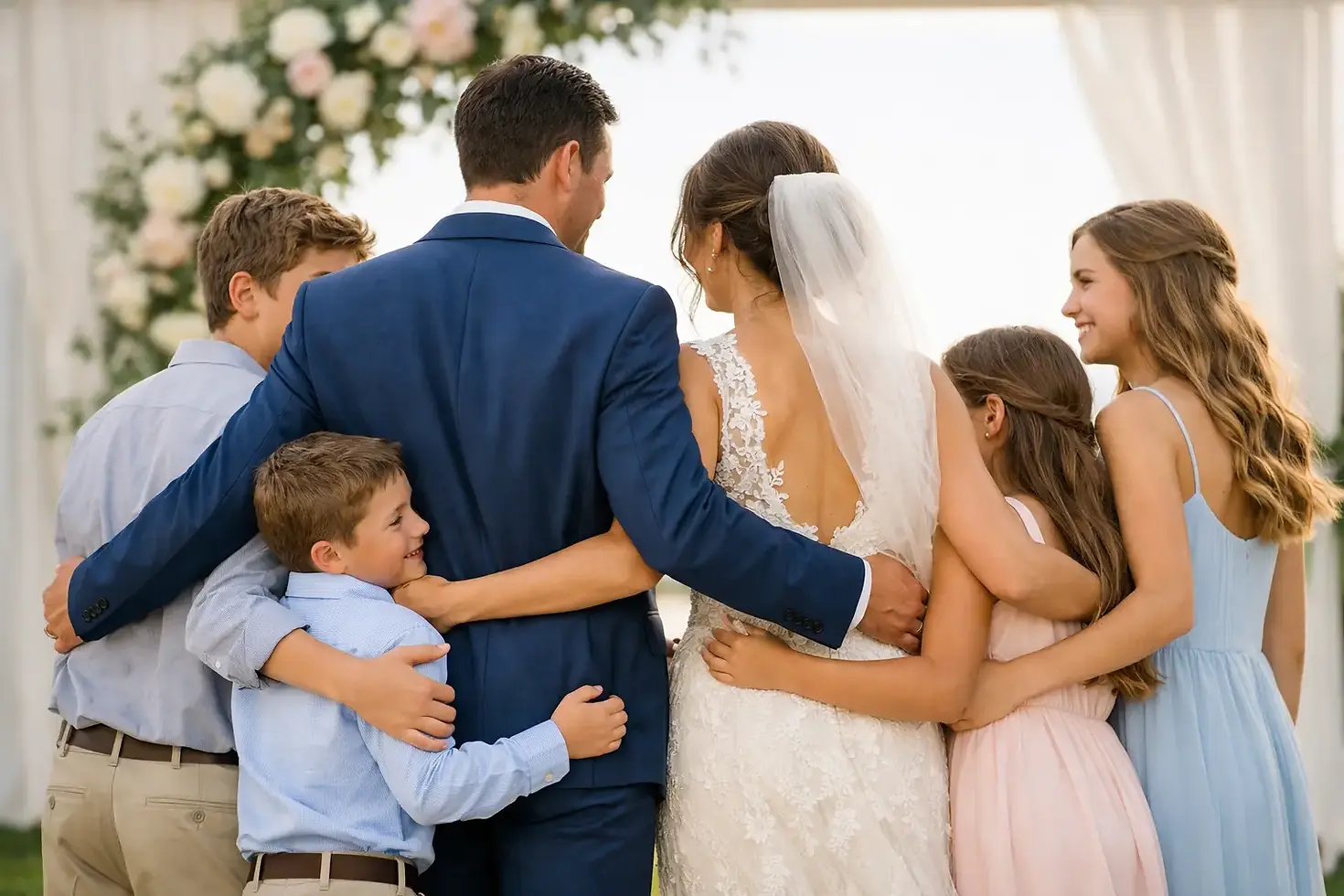
How to Honor Blended Families in Your Ceremony
- Hans Kissmann
- 6 days ago
- 5 min read
A blended family ceremony can hold a beautiful truth: love did not begin on the wedding day. It may have grown through school pickups, shared dinners, hard conversations, bedtime routines, and the quiet choice to keep showing up for one another. Learning how to honor blended families means creating space for that truth without asking anyone to pretend the path has been simple.
Whether you are planning a wedding, a vow renewal, or a family dedication, the goal is not to perform a picture-perfect version of family. It is to create a sacred moment that reflects the people standing together now, their individual histories, and the hopes they are choosing to carry forward.
Begin With the Family You Truly Are
Every blended family has its own shape. Some children have known a stepparent for years. Some are just beginning to build trust. Adult children may be celebrating their parent’s new partnership while still holding tenderness for a deceased parent, an absent parent, or the life that came before. There is no single script that can hold all of those realities well.
Before choosing rituals or wording, have honest conversations as a family. Ask what each person would like the ceremony to acknowledge, and what they would rather keep private. Children and teens, especially, should never be surprised by a public role or a promise they did not help shape.
A thoughtful ceremony does not require everyone to feel exactly the same thing. Joy and uncertainty can exist together. So can gratitude, grief, excitement, loyalty, and caution. When a ceremony makes room for those layered emotions, people are more likely to feel seen rather than pressured to play a part.
How to Honor Blended Families Without Forcing a Script
The language used in a ceremony matters deeply. A phrase like “becoming one family” may feel right for some people, but for others it can unintentionally erase the relationships, memories, and family bonds that already exist. It can also create an expectation that closeness must arrive immediately.
Often, gentler language carries more truth. You might speak of “joining lives,” “building a home together,” or “choosing to grow as a family.” These words recognize that family is not a finished product. It is a living relationship, shaped over time through care, patience, and mutual respect.
The same consideration applies to titles. Not every stepparent wants to be called Mom or Dad, and not every child is ready to use those names. A ceremony can honor a meaningful bond without assigning a label. Naming someone as a trusted adult, loving guide, steadfast supporter, or cherished part of the family may feel more accurate and more comfortable.
A personalized officiant can help find language that feels emotionally honest. At Ceremonies By Hans, that process begins with listening carefully to the stories beneath the celebration, including the parts that are tender, complicated, or still unfolding.
Invite Participation, Not Obligation
Including children in a wedding or dedication ceremony can be profoundly moving, but participation should always be an invitation. A child who loves the spotlight may want to read a poem, offer rings, walk down the aisle, or share a few words. Another may prefer a quieter role, such as placing a flower on the ceremony table, choosing a song, or standing close to a parent during a family blessing.
Teenagers and adult children may appreciate being consulted about the kind of role they want. Being asked is itself meaningful. It communicates that they are not simply guests at a milestone that changes their family life, but valued people whose feelings and presence matter.
If a child chooses not to participate publicly, honor that choice without disappointment. They can still be recognized in the ceremony through a brief acknowledgment, a private letter, or a meaningful gift exchanged before or after the event. Connection does not need an audience to be real.
Choose a Ritual That Feels Like You
A family ritual can give shape to a promise that is difficult to express in words alone. The right ritual is not necessarily the most elaborate one. It is the one that feels natural to your family and leaves everyone with a sense of belonging.
A sand ceremony, for example, can symbolize individual lives becoming part of a shared future while still retaining their distinct colors. A unity candle may offer a warm, visual expression of a new household. Planting a tree can represent patience, roots, and the ongoing work of tending a family over time.
Other families may prefer something less public. They might seal letters to be opened on a future anniversary, create a family time capsule, exchange meaningful keepsakes, or share a meal after the ceremony with a special toast for the children. There is no requirement to include a unity ritual at all. If it feels performative or uncomfortable, a few carefully written words may carry greater weight.
The trade-off is simple: rituals are memorable, but they should never become a substitute for emotional truth. Choose one because it reflects your values, not because it appears on a wedding checklist.
Make Promises That Leave Room to Grow
Many couples want to include vows to the children in their ceremony. These promises can be powerful when they are specific, realistic, and rooted in the relationship that already exists.
Rather than promising to replace someone, to make every day perfect, or to love in a way that demands an immediate response, consider promises of presence. A stepparent might promise to listen, to show patience, to make room for laughter, to offer support, and to keep earning trust. A parent might promise to protect the child’s place in the family while nurturing the new partnership.
This kind of language respects boundaries. It says, “I am here, I am committed, and I understand that relationships grow at their own pace.” For many blended families, that is more meaningful than any grand declaration.
Acknowledge the People Who Are Not Standing at the Altar
Honoring a new family chapter does not mean erasing previous ones. Depending on your circumstances, you may wish to acknowledge a late spouse, a beloved grandparent, a former family structure, or other people whose influence remains part of the story.
This must be handled with care. A public mention may be comforting to one family and painful or inappropriate to another, particularly when co-parenting relationships are strained or private. Sometimes the most respectful choice is a private moment before the ceremony: lighting a candle, placing a photograph nearby, wearing a keepsake, or simply pausing together.
The question is not whether the past should be present. The question is how to hold it in a way that supports the people you love. A compassionate ceremony understands that new joy does not require old love to disappear.
Give the Moment Time to Breathe
When people are trying not to cry, they often laugh. When emotions are high, a child may fidget, a teenager may look away, or someone may need a moment before joining in. These are not failures of the ceremony. They are signs that something real is happening.
Build in pauses. Let music play for a few extra moments. Ask your officiant to leave space after a family vow or ritual rather than rushing to the next line. The most memorable ceremonies often have room for an unexpected hug, a tearful smile, or a child’s spontaneous comment.
A blended family does not need to prove its love in one afternoon. A ceremony can simply mark a promise: that this family will keep making room for one another, keep listening, and keep choosing care. That is a beautiful place to begin.


Comments